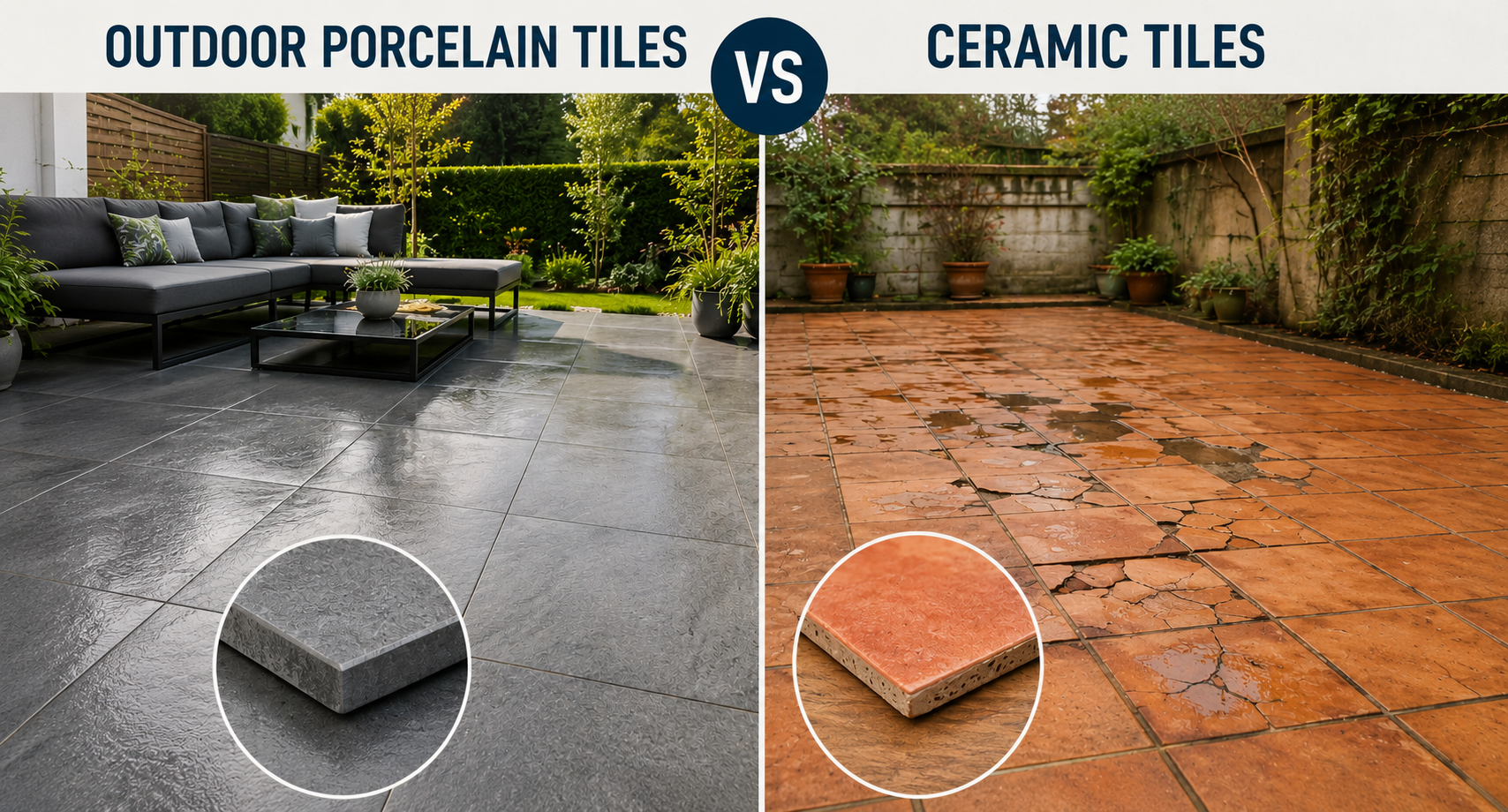
Outdoor porcelain tile is undeniably the best option for Irish patios because its exceptionally dense composition prevents water absorption, making it highly resistant to frost damage. Its textured surface are also better maintains grip in wet conditions. While standard ceramic options perform brilliantly inside hallways and kitchens, they lack the structural integrity required to survive an Irish winter. Selecting the wrong material leads directly to surface cracking, loose paving slabs, and dangerous garden walkways after just one seasonal freeze-thaw cycle.
Key Takeaways
- Porcelain is practically frost-proof: With a water absorption rate under 0.5%, it will not crack during freezing Irish winters.
- Ceramic is strictly for indoors: Its porous clay body absorbs moisture, causing the material to burst and shatter when temperatures drop below freezing.
- Safety requires an R11 slip rating: True external porcelain pavers feature a rough, textured surface designed to give maximum grip during heavy rainfall.
- Thickness matters for ground support: 20mm porcelain pavers are the preferred choice, to bear weight and resist ground shifting, whereas internal floors use 10mm tiles.
-
Low ongoing maintenance: Porcelain's dense surface makes moss and algae much easier to remove because they grow on the surface rather than within the material, making it incredibly easy to clean with basic soapy water.
Porcelain Tile vs Ceramic Tile: The Core Differences Explained
The core technical difference when comparing porcelain tile vs ceramic tile lies in the composition of the raw clay and the firing temperature inside the kiln. Both options start as natural earth materials, but the industrial processing determines their ultimate survival rate in an outdoor garden environment.
Porcelain is manufactured using highly refined, purified white clay mixed with finely ground sand and feldspar minerals. This mixture is compressed under massive hydraulic pressure and fired at extreme temperatures up to 1200 degrees Celsius. This process triggers vitrification, meaning the ingredients fuse into a dense, glassy, and virtually solid mass.
Standard ceramic options use coarser red or brown clay fired at much lower temperatures. The resulting product is far less dense, leaving tiny microscopic air pockets throughout the internal tile body. While a top glaze seals the face, the raw edges and base remain highly porous.

Why Outdoor Porcelain Tile Dominates
Irish climate conditions present severe challenges for domestic paving materials. Constant dampness, heavy winter downpours, and rapid overnight temperature drops mean your patio must be structurally resilient.
Defeating the Freeze-Thaw Destruction Cycle
When rainwater sits on a porous surface like traditional concrete flags or ceramic options, moisture sinks deep into the clay body. During a winter freeze that trapped water turns to ice.
As water freezes, it expands by roughly 9% in volume. This expansion generates immense pressure inside the tile. Over a typical winter, this cycle repeats dozens of times. The continuous internal stress quickly shears the glaze off ceramic surfaces, leaving a crumbled, dangerous mess. Because high-quality outdoor porcelain tile has a less than 0.5% water absorption rate, ice has no space to form, keeping the layout perfectly solid.
Long-Term Slip and Algae Resistance
Shaded garden spaces in Ireland are prime territory for green algae, lichen, and moss growth. Porous stones absorb organic spores, trapping dirt deep within the surface pits. This creates a slick, slimy film that turns a garden pathway into a major slip hazard.
The non-porous nature of vitrified porcelain gives organic matter no foothold. Spores cannot penetrate the face, keeping grime strictly on the surface. Cleaning simply involves an annual washdown, saving you hours of intense scrubbing or aggressive chemical treatments.
Selecting Your Paving Style and Material Depth
Planning a durable garden layout requires choosing materials engineered explicitly for external ground loads. True garden pavers look different and behave differently from thin internal flooring.
Why 20mm Thick Pavers Are Essential
You cannot lay standard 10mm indoor porcelain outside on a traditional sand and cement bed. Thin profiles lack the sheer physical mass to cope with ground movement, heavy garden planters, or shifting garden furniture. Heavy-duty 20mm outdoor porcelain pavers are structurally sound, allowing them to bridge minor sub-base movements without snapping.
Designing a Cohesive Outdoor Living Space
Modern manufacturing allows porcelain to mimic premium natural materials with total factual precision. Homeowners can achieve luxury design themes without the high-maintenance drawbacks of real stone:
- Natural stone replicas: Get the exact visual character of Portuguese limestone, Irish blue limestone, or dark grey granite without the need for regular chemical sealers.
- Contemporary concrete effects: Perfect for crisp, industrial garden styles that flow out from large glass kitchen extensions.
- Durable timber planks: Captures the warmth of cedar or oak decking without the rot, splinters, or slick surface hazards of real wood.
For practical advice on arranging these styles to suit your home, see our comprehensive guide on how to transform your patio with outdoor tile ideas and inspiration.
How to Lay Outdoor Porcelain Tiles for a Lifetime of Use
Because porcelain is entirely non-porous, traditional building methods will fail. Standard cement cannot grip the glass-like back of a porcelain paver. If you lay them directly onto wet sand, they will detach within months.
The Professional Solid Bed Installation Guide
- Dig out and prepare the sub-base: Depth: 100 mm to 150 mm. Excavate your patio site to a solid soil layer. Infill with a substantial layer of Clause 804 crushed stone, compacting it thoroughly with a vibrating plate compactor. Ensure you build in a permanent slope of 1 in 80 away from your house walls to guarantee efficient surface water run-off.
- Mix and apply a priming slurry: Critical for chemical bonding. Mix a dedicated polymer-modified priming slurry. Brush this thick mixture across the entire back of the paver right before setting it down. This slurry layer creates the essential chemical bridge needed to link the smooth porcelain body to the mortar bed below.
- Set on a full bed of mortar: Thickness: 30 mm to 50 mm. Lay the primed pavers onto a full, wet mix bed consisting of four parts grit sand to one part ordinary Portland cement. Never use the dot-and-dab method. Void spaces underneath the paving stones catch rainwater, which freezes, expands, and pops the surface tiles loose.
- Grout with external jointing compound: Joint width: 3mm to 5mm. Fill your layout gaps using a high-performance, water-repellent exterior paving jointing compound or a flexible brush-in resin compound. Maintain a clean, consistent spacer gap to safely handle natural ground movement and summer thermal expansion.
- Allow for movement joints. Large patios should include movement joints in accordance with good installation practice. Perimeter joints should also be left around walls, steps and fixed structures to accommodate thermal expansion and help prevent cracking or tenting.
Frequently Asked Questions
Can I buy outdoor porcelain tiles in Cork or Dundalk?
Yes, you can buy our full range online with fast nationwide delivery, or visit our dedicated showrooms to view large floor displays in person. For customers in the south west, you can browse premium options at our Cork tile store, while customers in the north east can visit our fully stocked Dundalk tile store. Both locations feature our complete selection of 20mm frost-proof external pavers and matching indoor floor tile options.
How is laying outdoor porcelain tiles different to natural stone flags?
Yes, learning how to lay outdoor porcelain tiles requires a specific extra step: you must apply a polymer priming slurry to the back of every single tile before positioning it on the wet mortar. Natural sandstone and concrete are naturally porous and stick easily to cement, but vitrified porcelain requires this chemical bonding agent to stay permanently locked to the ground base.
Do I need to buy specialised outdoor porcelain tiles due to rain?
Yes, buying dedicated outdoor porcelain tiles Ireland specification items ensures you receive an R11 slip-resistant finish. This texture features a coarse, sandpaper-like surface feel that provides critical underfoot traction during heavy downpours, preventing slips and falls on wet winter afternoons.
Is outdoor porcelain tile much more expensive to install than ceramic?
The initial material cost is higher because porcelain requires refined raw ingredients and massive kiln energy to manufacture. The installation also demands specific materials like priming slurry and high-grade external grouts. However, because it lasts for decades without cracking or rotting, it offers far greater long-term value than cheap ceramic or timber alternatives.
Will the sun fade my outdoor porcelain pavers over the summer?
No, high-quality outdoor porcelain pavers are completely UV-resistant. The colour pigments are baked deep into the clay body at over 1000 degrees, meaning your patio will be highly UV resistant, retaining its colour for many years to come in normal outdoor conditions.
Can I clean my exterior porcelain patio with a pressure washer?
Yes, you can use a standard home power washer on your porcelain patio without any risk of damaging the dense tiles. Keep the spray nozzle at a reasonable angle and avoid blasting directly into the grout joints for extended periods to ensure the jointing compound stays perfectly intact.